

Problem Overview
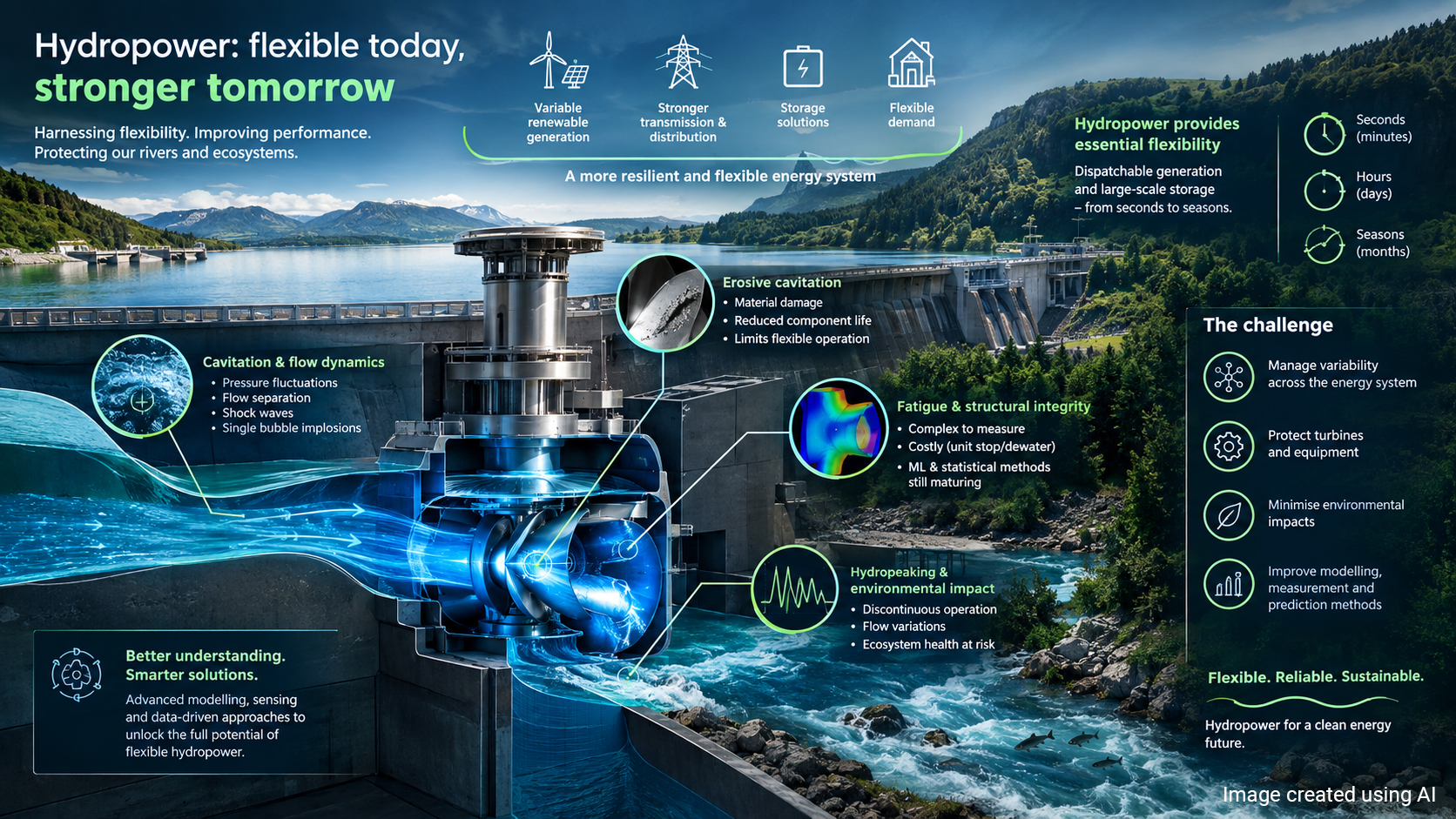
To effectively manage large-scale variable renewable energy generation, flexibility has to be harnessed in all sectors of the energy system, from power generation to stronger transmission and distribution systems, storage, and more flexible demand. Having a dispatchable power generation and high potential for storage capacity, hydropower already provides essential flexibility to the grid on multiple time-scales from short-term to seasonal. However, flexible operation can be harmful for the electro-mechanical equipment and lead to severe environmental impacts caused by variations in the flow.
Flexible operation often requires turbines to run at partial load or low head off-design points. In such operating conditions, pressure fluctuations and flow separation intensify fatigue and cavitation phenomena, which in turn compromise the structural integrity of the turbine components and accelerate cavitation-induced erosion by preventing operation and, therefore, limiting the flexibility of the plant. Furthermore, flexibility often leads to discontinuous operation, which can lead to hydropeaking effects which endanger the ecosystem health.
Innovation Details
TIES will develop optimized axial turbine designs capable of efficient operation over extended ranges, with reduced fatigue and cavitation risks, while ensuring fish-friendly performance. The innovation lies in the development of an integrated methodology including numerical simulations and data-driven models which will feed into industrial tools for turbine design. Unsteady simulations to capture vorticities and their structural impacts on the blades, and models of cavitation behaviour including shock waves will be combined and integrated in Finite Element Models (FEM) fatigue simulations.
On-site experimental techniques will be employed, such as the inclusion of acoustic emission sensors on the rotating frame, coupled with other sensors, to provide valuable validation and calibration of cavitation models that can be applied in further hydropower studies. Machine learning methods will be deployed to perform the indirect estimation of stresses based on simplified quantities directly measured on-site. The results will be integrated with existing manufacturer numerical models, design tools respecting fish friendliness, and use-case data including operational and environmental parameters, from which an optimized propeller or Kaplan turbine runner geometry will be proposed (TRL 5).
WP Lead parther:
GE Vernova