

Problem Overview
Hydropeaking caused by hydropower plants creates rapid sub-daily fluctuations in discharge, current velocity, and water level, with well-documented negative impacts on fish and macroinvertebrates, including displacement, stranding, habitat loss, and increased energetic costs13. A variety of mitigation measures have been proposed, ranging from operational adjustments to morphological restoration, but most reduce hydropower flexibility or require high investment costs.
Innovation Details
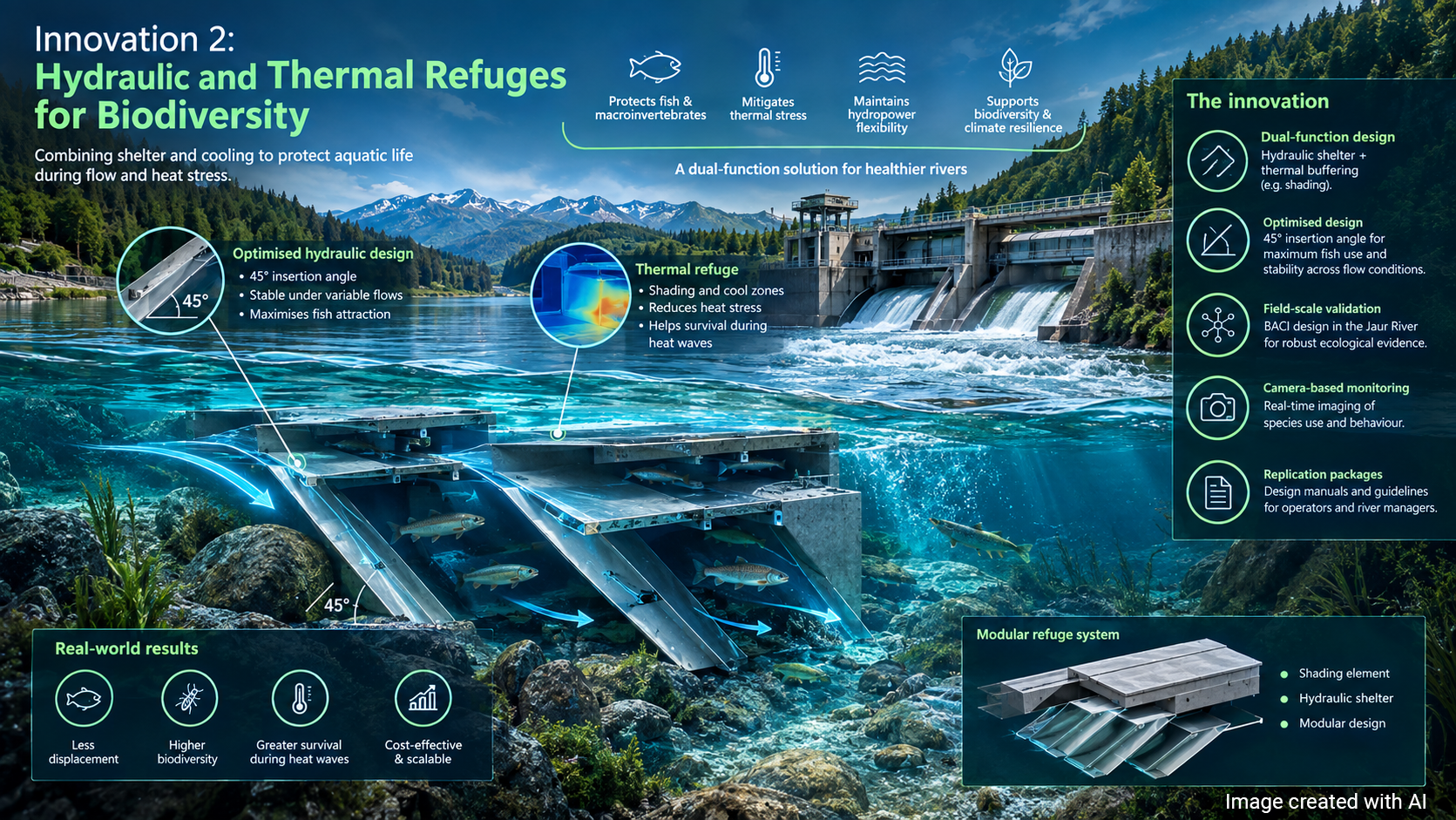
TIES will pioneer the development of modular hydraulic-and-thermal refuges, combining physical shelter from rapid flow ramps and peak flows with temperature-buffering functions to mitigate heat-wave impacts. The innovation lies in:
> Dual-function design: the refuges will integrate hydraulic shelters with thermal refuge capacity (e.g., through shading), addressing two major stressors simultaneously.
> Optimized refuge design: built on laboratory evidence that 45° refuges maximize fish use, designs will be refined to ensure stability and accessibility under a wide range of hydropeaking conditions.
> Field-scale BACI validation: the refuges will be tested in the Jaur River, with a before–after–control–impact (BACI) design providing robust ecological validation on effectiveness.
> Camera-based monitoring: novel imaging systems will quantify refuge attractiveness and species use in real time, generating unprecedented datasets on multi-species behavioural responses.
> Replication packages: guidelines and design manuals will be delivered to hydropower operators and river managers, enabling scaling and adaptation to other rivers.
WP Lead parther:
ISTID