


Problem Overview
Streamflow prediction and forecasting are essential for water resources management and, undoubtedly, to effectively manage reservoirs, optimizing water use, energy production, and mitigating the often devastating effects of floods and droughts. This effort has relied on classical hydrological models for decades. The complexity of meteorological and hydrological processes, however, has:
1) Limited the accuracy of forecasts and;
2) forced hydrologists to grapple with uncertainty and move toward probabilistic approaches.
At the present time, the development of machine-learning (ML) forecasting models is likely the best bet to improve predictions18. Adding to their appeal, ML’s operational implementation is also conceptually easier, more scalable, and extendable to multiple variables and conditions. Notably, ML architectures can predict river discharges, sediment concentrations, and other relevant variables, even evidencing success in ungauged catchments. State-of-the-art ML displays the capability to learn underlying hydrological processes and apply that knowledge in new contexts. Indeed, within the connections of deep neural networks, useful knowledge can be shared between related tasks—for example, when simultaneously predicting streamflow and sediment transport. Today, issues related to extreme events, applicability in ungauged catchments and explainability remain. Decision-making based on forecasts is best when supported by an optimization scheme. Today’s optimization schemes (e.g., based on dynamic programming or evolutionary algorithms) struggle to fully account for probabilistic inputs and biodiversity effects.
Innovation Details
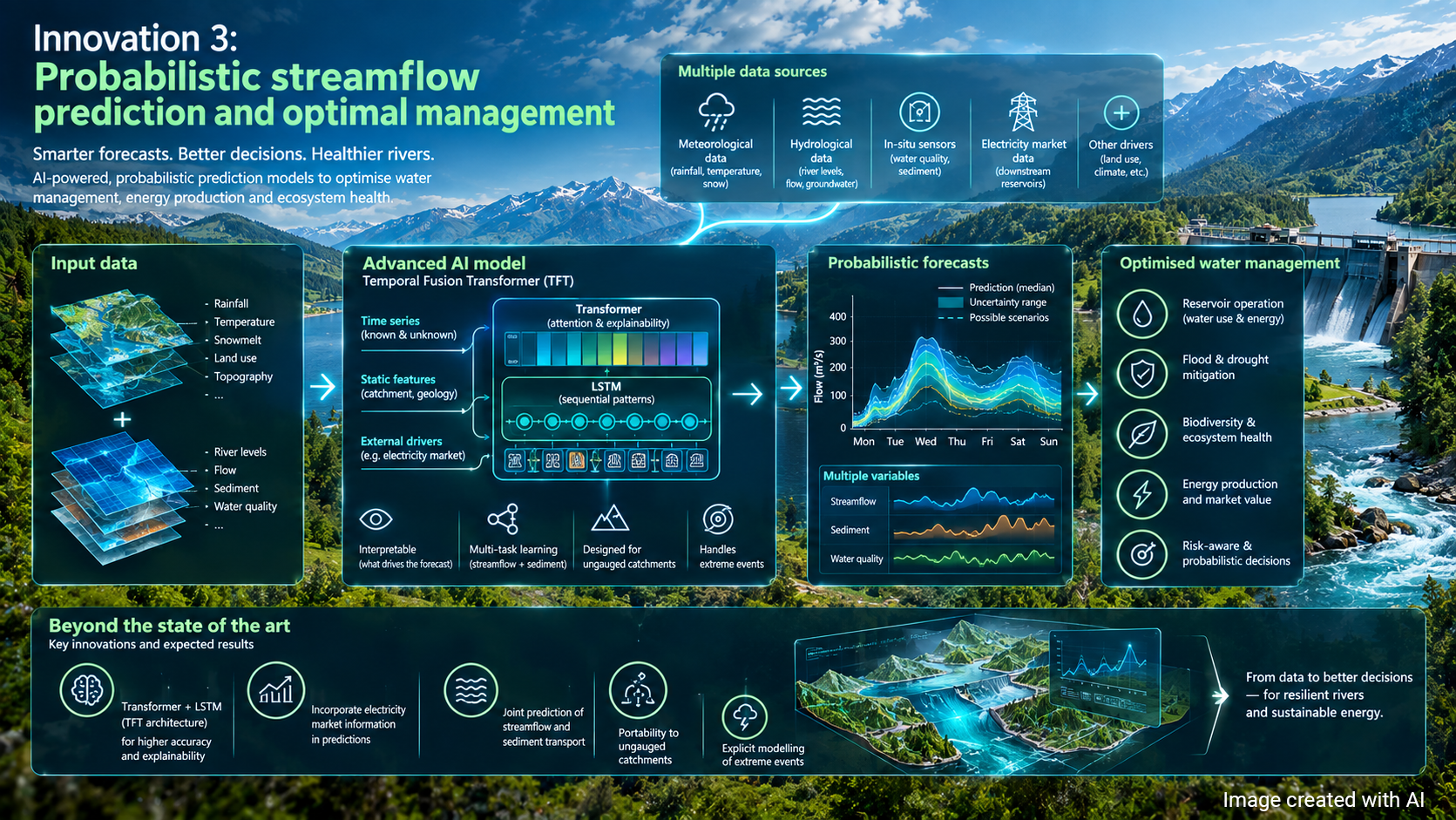
TIES will optimize water management by integrating innovative probabilistic machine learning forecasting models that incorporate natural and anthropogenic drivers. The prediction of streamflow will by achieved by employing the combination of Transformers and Long-Short-Term Memory (LSTM) blended into Temporal Fusion Transformers (TFT). The implementation will depart from similar approaches recently attempted in the hydrological sciences by:
1) Taking advantage of the “Transformer” component of the TFT, that facilitates the direct explainability of results (the model outputs which variables influence its predictions at every time step);
2) incorporating electricity market information in predictions (highly relevant downstream of existing reservoirs);
3) aggregating streamflow and sediment transport prediction;
4) exploring portability to ungauged catchments and;
5) characterizing the predictive behaviour of extreme events. Advances in optimization hinge on the use of probabilistic predictions, acting on the translation of uncertainty ranges to coherent possible paths the forecasts may take and aiming for the simultaneous maximization of expected outcomes and limitation of risks.
WP Lead parther:
ISTID