


Problem Overview
Dams interrupt the natural flow of sediments in rivers, causing them to settle once they reach the reservoir. Sedimentation upstream of dams (whether large storage reservoirs or smaller run-of-the-river projects) poses serious environmental and technical challenges. From an environmental perspective, sedimentation disrupts the natural continuity of sediment transport, leading to sediment starvation, channel incision, and coastal retreat, with severe consequences for ecosystems and human infrastructure.
From a technical perspective, accumulated sediments can shorten a project’s lifespan by clogging and abrading mechanical equipment and outlet works, while also reducing reservoir storage capacity. This loss of capacity diminishes operational flexibility and hinders the multiple services reservoirs provide. Despite these well-documented concerns, data and models on reservoir sedimentation remain scarce, resulting in an incomplete understanding of the problem and uncoordinated mitigation efforts. In practice, dam operators and owners often respond reactively to isolated sedimentation issues rather than adopting proactive management strategies. This reactive approach leads to poor planning, ineffective sediment management, and potential revenue losses.
Therefore, improved forecasting of sediment influx and sustainable sediment management at dams are urgently needed. At the same time, another significant uncertainty typically identified by dam operators and practitioners is the lack of methods to represent sediment distribution within the reservoir. This information is crucial for accurately determining volume-elevation curves, which are essential for effective dam operation planning and for biogeochemical processes (e.g., leading to greenhouse gas emissions). This also limits the ability to conduct sedimentation monitoring upstream of dams (e.g., bathymetric surveys) in a practical and sustainable way. Therefore, there is a critical need to better understand sediment dynamics upstream of dams and for better coordinated operational strategies to enhance sediment passage while maintaining reservoir productivity.
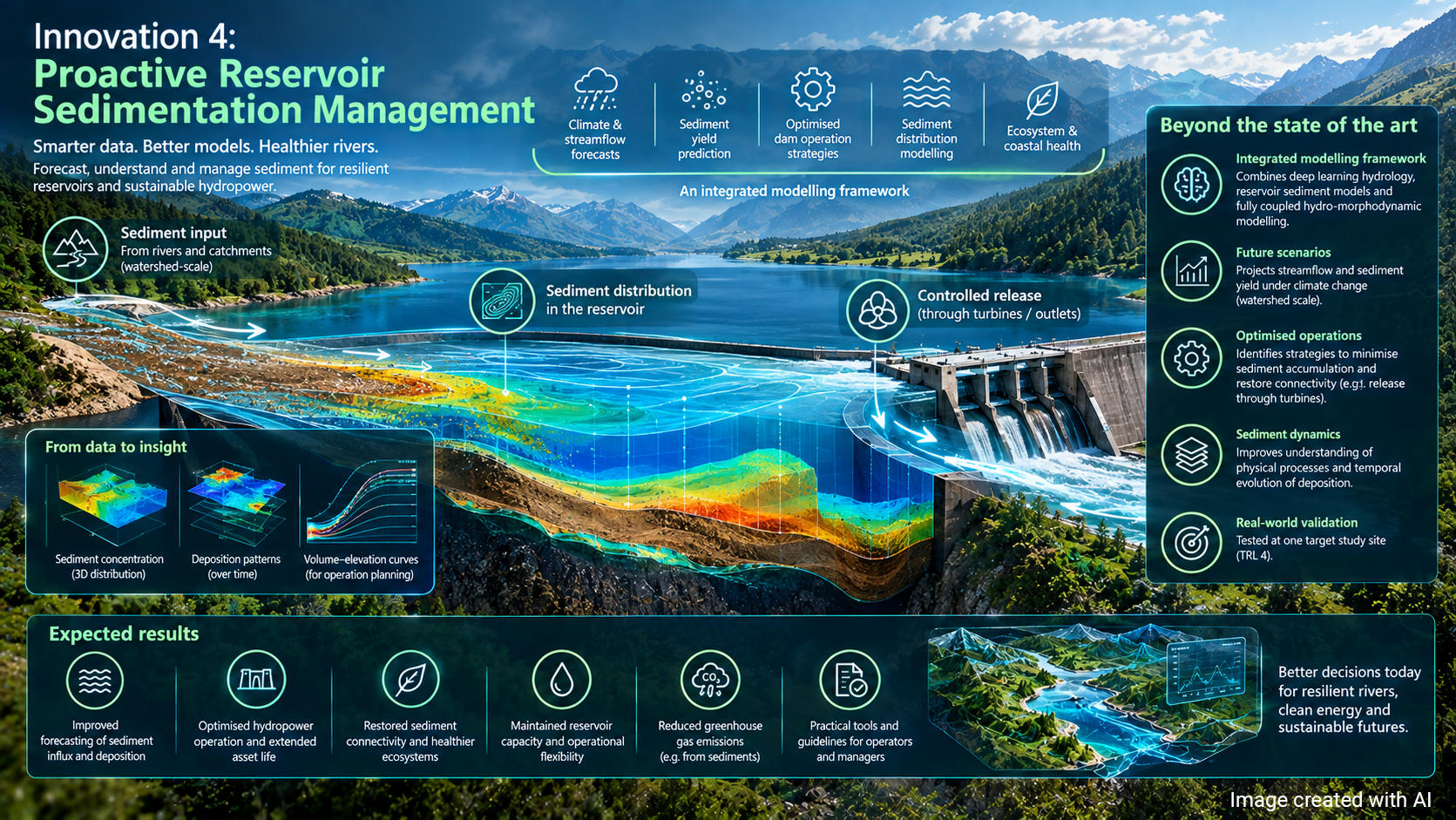
Innovation Details
By establishing a numerical modelling framework, TIES will address key knowledge gaps:
(1) Projecting future watershed-scale streamflow and sediment yield under climate change;
(2) identifying optimal hydropower dam operation strategies, including release-throughturbines, to minimize future reservoir sediment accumulation and restore sediments connectivity, and;
(3) improving our understanding of the physical processes governing the temporal evolution of sediment deposition in reservoirs.
The framework will integrate deep learning hydrological models with reservoir models that simulate sediment deposition and the effects of hydropower operations (e.g., CASCADE23), as well as a fully coupled hydromorphodynamic model capable of representing sediment distribution and deposition patterns within reservoirs. As an initial step towards developing this integrated system, we will focus on one target study site.
WP Lead parther:
EFL