


Problem Overview
The monitoring of the silt erosion process in hydraulic turbines is an extremely challenging task. Some solutions have been proposed for Pelton turbines, such as the WearScan, and others are under development, such as those from the project ReHydro. All these systems, based on smart cameras, estimating the erosion progress through the analysis of images, are perfect for Pelton turbines, offering a direct optical access to eroded buckets, but these are not applicable to reaction turbines (Francis and Kaplan) due to the lack of optical access, of lighting and of clean surfaces.
A recent publication showed the potential of analysis of the vibratory response of a Pelton runner to detect erosion. For reaction turbines, one solution was proposed by Voith Hydro for reaction turbines but this system monitors the sediment concentration in the turbine for predictive maintenance purposes. At the time, no technology for monitoring and predicting the erosion progression has been proposed.
Innovation Details
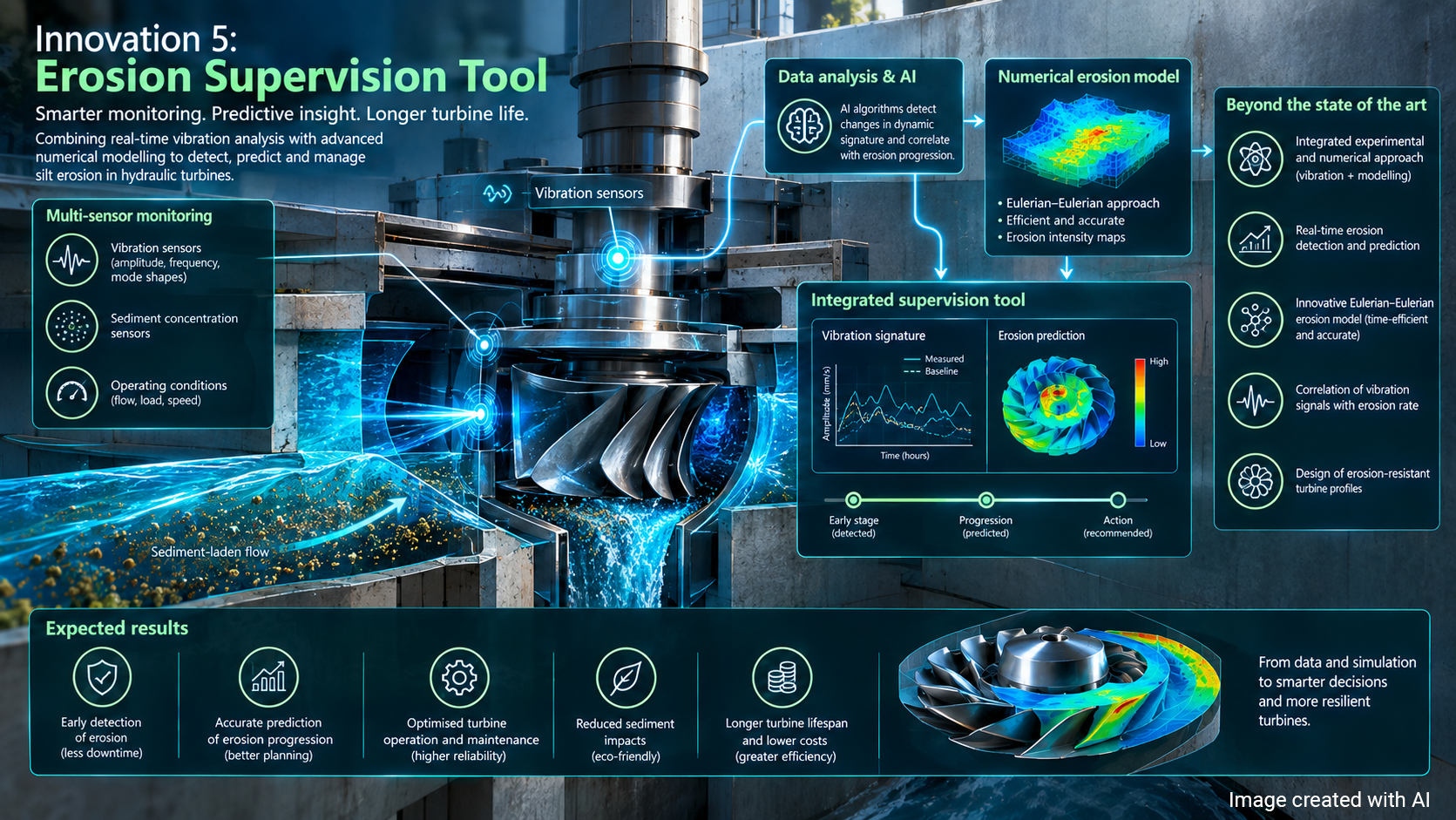
TIES will develop an erosion supervision tool, combining experimental field and reduced-scale model measurements of the vibratory behaviour (amplitude, frequency, and mode shapes) of a turbine undergoing through an erosion process and a numerical predictive erosion model for the erosion assessment. This tool will be capable of detecting the variation of the dynamic signature of the machine due to the erosion and will correlate this with the erosion progress according to the model forecast so as to inform about the erosion degradation in operation.
Since at the very beginning of the erosion process the changes in dynamic signature are expected to be not so significant, this experimental approach will be combined with numerical predictions of the erosion progress, given a certain monitored sediment concentration on the machine. To avoid excessive computational time, an innovative erosion model suitable for being coupled with Eulerian – Eulerian simulations will be developed. This numerical approach will provide in reasonable time erosion intensity maps.
The tool will be trained to analyse vibration signals so as to capture possible variations of the dynamic signature and it will periodically compare numerical erosion intensity maps with the dynamic signature to better assess the erosion evolution supervision. The innovation of this integrated numerical approach will be also leveraged in TIES to design innovative Francis turbine profiles, which can strengthen turbine resistance to silt erosion wear including in conditions of increased sediment flushing to restore sediments connectivity.
WP Lead parther:
UNIPD