

Problem Overview
Digital twins are virtual representations of physical systems that are dynamically linked to their real world counterparts through continuous data exchange. Their primary purpose is to enable monitoring, simulation, and optimization by integrating sensor data, historical records, and predictive models within a unified digital environment. This coupling allows stakeholders to analyze system behavior in real time, test hypothetical scenarios, and anticipate future states without interfering with the physical system.
The state-of-the-art in digital twin research and applications spans domains such as manufacturing, energy systems, urban infrastructure, and healthcare. Recent developments emphasize high-fidelity modelling, incorporation of machine learning for predictive analytics, and interoperability across heterogeneous data sources. Advances in data acquisition, cloud computing, and edge processing have further strengthened the scalability and responsiveness of digital twins, enabling deployment in complex, distributed environments. Overall, digital twins represent a transformative paradigm for bridging the physical and digital worlds, with growing significance in supporting real-time decision-making, predictive maintenance, and sustainable system design.
Innovation Details
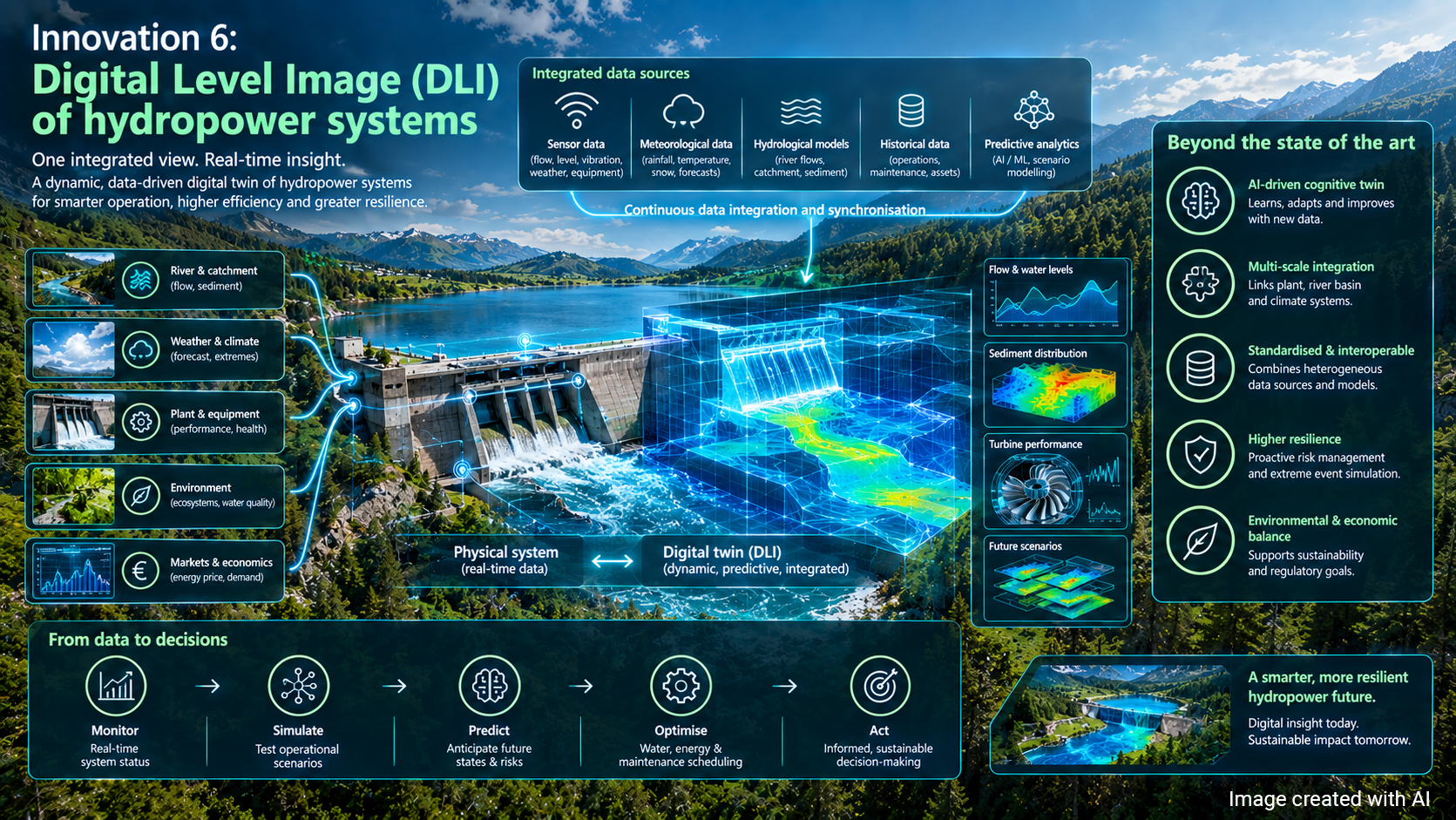
Current challenges in digital twin research include ensuring data quality and synchronization, developing standards for interoperability, and balancing model complexity with usability. Emerging trends point toward cognitive digital twins that incorporate artificial intelligence for autonomous adaptation, and multi-scale or system-of-systems twins that integrate diverse subsystems into holistic representations. In this project, we will develop a digital level image (DLI) of hydropower systems, which describes a digital twin version of hydropower operation.
The DLI provides a dynamic, data-driven representation of plant infrastructure and its surrounding environment. Traditional monitoring and control systems in hydropower cannot integrate heterogeneous factors into a coherent operational perspective. With the DLI, we address this challenge by combining sensor data, hydrological and meteorological models, and predictive analytics into a continuously updated virtual model of the plant and river system. The DLI enables us to monitor performance in real time, simulate operational scenarios, and anticipate the impacts of extreme weather or long-term climate change.
Such capabilities support optimized water resource management, improved energy scheduling, and proactive maintenance, ultimately enhancing both efficiency and resilience. Furthermore, the DLI facilitates cross-domain integration by linking technical, environmental, and economic data, thus supporting informed decision-making in line with sustainability and regulatory objectives.
WP Lead parther:
Tu Wien